When a roof starts letting you down, the first question most homeowners ask is whether it can be repaired or needs replacing. The honest answer is that it depends on the roof. Plenty of tired-looking roofs only need a targeted repair, while others have reached the point where more patching is money spent on borrowed time. This guide explains how DJW Roofing & Leadwork weighs up repair against replacement on homes in Ely, Littleport and across Cambridgeshire.
Start with the age and condition of the roof
Every roof has a working life, but no single number applies to every home. How long a roof lasts depends on the material, how well it was installed and how exposed it is. Natural slate and good clay tiles can last many decades, concrete tiles tend to wear sooner, and older felt flat roofs usually have the shortest life.
An older roof coming to the end of its life tends to show problems everywhere at once. Tiles or slates become soft, flaky or porous, nails rust through so pieces slip in several places, the underlay beneath sags or crumbles, and the roof line may dip between the rafters. A sound roof with a local problem looks quite different: most of the covering is firm and well fixed, and the trouble is limited to one area, such as a single slipped tile, a cracked ridge or a tired piece of lead flashing.
When a repair is usually the right call
If the rest of the roof is sound, a repair is usually the sensible and cost-effective choice. Typical examples include a few slipped or cracked tiles or slates, a localised leak around one feature, failed or split lead flashing, a loose ridge or verge, a damaged chimney flashing, or storm damage confined to one part of the roof.
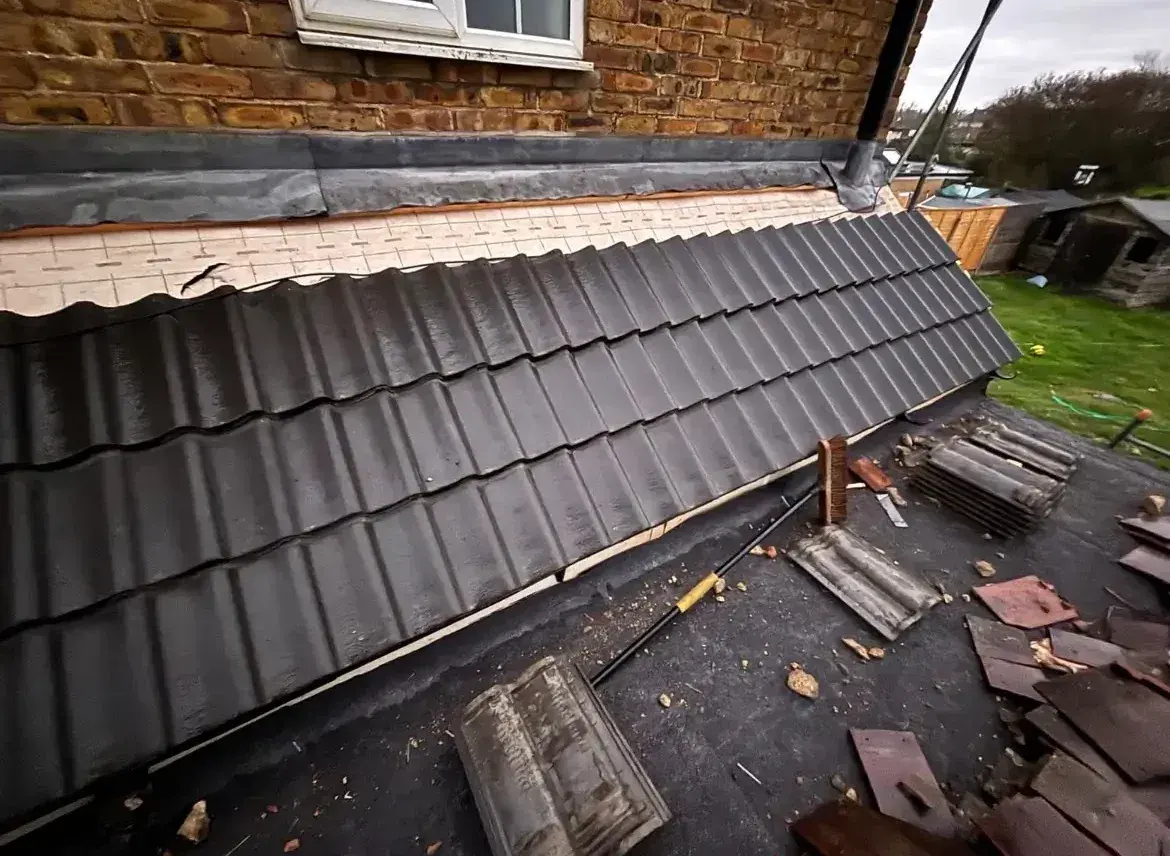
Problems like these can normally be fixed properly without disturbing the rest of the roof. Replacing a handful of tiles, re-dressing or renewing lead, re-bedding or mechanically fixing a ridge, or sealing around a chimney all put the roof back into good working order. Our roof repairs page explains the everyday repairs we carry out, and we also cover specialist leadwork, chimney repairs and dry ridge and verge systems for the most common trouble spots.
When replacement starts to make more sense
There comes a point where repairs stop being good value. Signs that a roof is heading that way include widespread slipped or porous tiles, sagging across the roof slope, repeated leaks appearing in different places, nail fatigue where the fixings are rusting through across large areas, and failed underlay or roofing felt that no longer sheds water that gets past the tiles.
A roof that has already had lots of patch repairs is another warning sign. If it keeps needing attention in new places, the covering as a whole is usually wearing out, and one more repair may only delay a replacement while leaks keep damaging battens, timbers and ceilings.
A full re-roof lets everything be done properly in one go: new underlay, new battens, sound fixings, renewed leadwork and a new covering that suits the house. Our new roofs and re-roofing page explains how we approach a replacement from start to finish.
Flat roofs are a special case
Flat roofs over extensions, garages and dormers follow slightly different rules. Older felt roofs often show their age through blistering, where pockets of air or moisture lift the surface, ponding, where water sits in puddles after rain, and cracking or splitting as the felt dries out and loses flexibility.
A small split on an otherwise sound flat roof can often be patched. But if the felt is blistered and cracked across much of the roof, water ponds in several places or the deck has gone soft, re-covering the roof, often in EPDM rubber, is usually the better long-term answer.
You can read more about our EPDM flat roofing service, and our guide to EPDM vs felt flat roofs compares the two materials in more detail.
What a proper roof inspection should tell you
Whichever way the decision goes, it should be based on a proper look at the roof. A good inspection should leave you with photos of what was found, a clear explanation in plain English, and an honest recommendation about what the roof actually needs.
That is how we work. We show you what we have seen, explain whether the problem is local or widespread, and tell you plainly what is needed. We will not recommend a new roof when a repair will do.
We offer free roof inspections and free, no-obligation quotes, and all of our work is fully insured and guaranteed.
Things to check from the ground (safely)
There is plenty you can check yourself without going anywhere near a ladder. Inside, look for stains or damp patches on ceilings, especially after heavy rain. If you can safely get into the loft, check for daylight showing through the roof, damp timbers or wet insulation.
Outside, look at the roof from the ground or an upstairs window for missing or slipped tiles, heavy moss, cracked ridge mortar and lifted lead. Granules or bits of broken tile in the gutters can also be a sign that the covering is wearing.
Never climb onto the roof yourself. Roofs are dangerous even in good weather, and older tiles and slates can break underfoot. Our guides to signs your roof needs repair and what to do about a roof leak after heavy rain explain more about what to look for and when to call a roofer.
Next steps
If you are not sure whether your roof needs a repair or a replacement, the simplest next step is to have it looked at. DJW Roofing & Leadwork has more than 20 years of roofing experience and works from our base in Littleport, covering Ely, Littleport and homes across Cambridgeshire.
Request a free inspection and quote and we will give you an honest view of what your roof needs. You can also find out more about our work as roofers in Ely and roofers in Littleport.
Frequently asked questions
Can you repair part of a roof instead of replacing it?
Yes, in many cases. If most of the roof is sound and the problem is limited to one area, such as slipped tiles, a loose ridge or failed lead flashing, a targeted repair is usually the right choice. Replacement only makes sense when problems are widespread across the roof.
How do I know if my roof needs replacing?
Common signs include widespread slipped or porous tiles, sagging, repeated leaks in different places, rusting nails across large areas, failed underlay and a history of many patch repairs. A professional inspection with photos is the most reliable way to know for sure.
Do I need planning permission to replace my roof?
Replacing a roof like-for-like often does not need planning permission, but listed buildings, conservation areas and changes to the roof's appearance or shape can be different. Our guide to [planning permission for a new roof](/guides/planning-permission-new-roof) explains the main points.